
PHARMA LAB · PL-04-015
Laboratory ovens: qualification and temperature uniformity
In this article
An oven may reach its setpoint quickly while part of the load is still heating. It can also maintain a stable reading despite differences between shelves. Qualification must therefore demonstrate that configuration and operating practice support the intended method, connecting measurements, load and criteria before testing begins.
This guide concerns declared laboratory drying and treatment applications. It does not turn a qualified oven into a validated sterilization or depyrogenation process, nor demonstrate the treatment’s analytical outcome by itself.
Define the application and expected outcome
Identify method, version, material, container and purpose. Specify the conditions to maintain and the event starting the treatment time. “One hour in the oven” is ambiguous unless it means insertion, attainment of conditions or another method-defined point.
If the method specifies an endpoint such as constant mass, apply it according to the relevant text; do not automatically replace it with a fixed time. Equally, do not invent a new criterion to compensate for incomplete qualification. Equipment thermal capability and procedure outcome remain related but different evidence.
Translate intended use into verifiable requirements: range, usable volume, permitted loads, records, safeguards and responsibilities. Annex 15 provides the qualification framework within applicable GMP scope. [1]
Describe configuration, installation and load
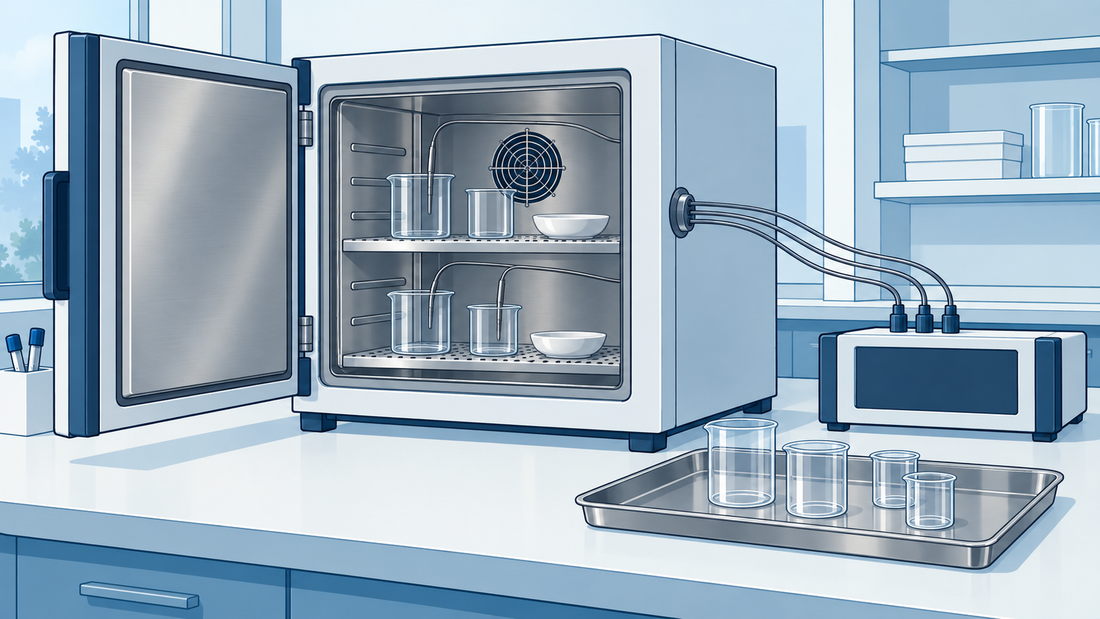
Record natural or forced convection, shelves, fans, intended openings, accessories and control sensor. Document installation location, power, clearances and ventilation requirements. Internal dimensions do not automatically equal the volume usable for the method.
Describe the load by number, mass, geometry, container material, arrangement and relevant contents. A full tray can obstruct airflow; larger containers may change thermal response despite identical total mass. Empty conditions help characterize the unit but cannot replace representative operating conditions.
Define a reproducible configuration and variants to include. If using a simulated load, justify which characteristics it represents and which it does not. Keep a diagram or photographs rather than relying solely on the label “maximum load”.
Select references and positions consistent with the measurement
Select calibrated references with suitable range, uncertainty, response and compatibility. Consider the complete chain: probe, connections, channels, acquisition and data processing. A sensor suitable for the temperature is not necessarily suitable for the intended geometry or duration.
Design positions around usable volume, shelves, circulation, loading and potentially critical locations. No grid fits every oven. An air measurement requires positioning that does not accidentally become a contact measurement on a wall or container.
Assess effects of radiation, conduction and cable routing on measurement. EURAMET cg-20 distinguishes indication, distribution, stability and uncertainty contributions in controlled enclosures. [2] It is metrological guidance, not an automatic source of process acceptance criteria.
Separate distribution, stability and material response
Spatial distribution compares positions; temporal stability describes the profile at one position. Indication deviation compares display and reference under defined conditions. Keep these assessments separate: a single average may hide the critical position or period.
Record heat-up, any transient overshoot, stabilization and holding for the planned scenarios. Where the decision concerns material, measurement or justification representative of its response is needed, not air temperature alone.
Define in advance how to identify the evaluated segment and start of the required phase. Do not select only the favorable part afterward. The distinctions between stability and recovery in incubator mapping are useful, but do not transfer times or limits between applications.
| Use or configuration | Thermal risk | Relevant test | Required evidence |
|---|---|---|---|
| A few distributed containers | Different responses by position | Distribution and stability within occupied volume | Time series linked to positions and loading |
| Denser load | Obstructed airflow and slower heat-up | Verification of new arrangement and response | Justified comparison against the method |
| Initially colder material | Delay before required condition | Representative load profile | Declared criterion for phase start |
| Planned opening during use | Loss of conditions and recovery | Authorized opening scenario | Times, positions and applicable limits |
| Modified shelf or fan | Changed circulation | Tests of affected functions | Change assessment and return to use |
Include operating scenarios and safety
Include openings, insertions or load changes only where part of authorized use. Define how to protect operators and materials, conditions stopping the test and configuration restoration. Do not bypass safeguards to obtain an uninterrupted trace.
Ovens do not accept every solvent or material merely because they reach the required temperature. Assess toxicity, vapors, compatibility, ventilation and safeguards with competent personnel and relevant instructions. Princeton EHS highlights hazards from volatilized substances and glassware containing organic residues. [3]
Ventilation needed for safety must be compatible with installation and qualified performance. Do not improvise connections or exhaust changes. Handling hot loads, surfaces and cooling requires procedures and protection appropriate to the activity.
Set criteria and make the report reusable
Predefine criteria for relevant quantities, scenarios, acquisition and uncertainty handling. Justify point number and placement, observation duration and loads. Method limits, equipment specifications and qualification criteria are not automatically interchangeable.
The report should link requirements, configuration, original data, calculations, deviations and conclusion. Show results by position and phase, with understandable units and assessment rules. “Pass” without the tested boundary does not inform the user.
State restrictions: permitted volume, arrangement, range, programs and covered openings. If a zone fails criteria, do not simply remove it from calculations; assess an approved physical and procedural restriction or an intervention followed by necessary verification.
Maintain suitability after qualification
Link routine checks, maintenance and periodic verification to unit criticality and history. Cleaning, seal wear, fan, sensor, controller or shelves can affect performance. Adjustment is not calibration, and repair does not automatically demonstrate restored suitability.
Also assess new loads and method changes. Define repeated tests according to affected functions, documenting approval and release to use. If deteriorated performance emerges, consider earlier materials and results using the laboratory excursion assessment.
Simulated case: same program, denser load
A laboratory moves from a few spaced containers to a densely occupied tray. This case is simulated. The display reaches setpoint as before, but this does not prove that every position and material follows the same profile.
Before routine use, assess circulation, distribution and response of the new load against the method. If time or arrangement must change, approve and verify the change; do not mechanically reuse the previous program. Return to the Laboratory Equipment & Controlled Storage hub.
Sources and scope
Verified: October 1, 2026. Original GuideGxP matrix and case. No probe count, time or permitted solvent is generalized.
- EU GMP Annex 15, 2015: qualification and lifecycle in the applicable scope.
- EURAMET Calibration Guide No. 20, version 5.0, September 2017: metrological characterization of normal-pressure enclosures; historical standards cited within it are not assumed to be current editions.
- Princeton EHS, Heating Devices, Ovens section, institutional webpage without visible revision date: hazard reference, not a universal local prescription.
Continue exploring

PL-04-021
Laboratory fume hoods: selection and performance verification
Acceptable air velocity alone does not describe containment. An original matrix connects operations, requirements and on-site verification.
Read the article
PL-04-020
Laboratory pure water: quality, selection and use
The display value does not describe the entire water pathway. An original matrix connects applications, interferents and controls through final preparation.
Read the article
PL-04-019
Laboratory glassware washers: qualification, rinsing and residues
A completed cycle cannot prove every cleaning requirement. An original matrix connects residues, surfaces, controls and limits of interpretation.
Read the article