
PHARMA LAB · PL-02-021
Laminar flow clean bench or biological safety cabinet: which to choose?
In this article
Laminar flow clean bench or biological safety cabinet? The right question is what protection the actual activity needs. A clean surface, HEPA filter or similar appearance does not make two devices interchangeable.
1. Start with personnel, sample and environment
Describe materials, condition, open operations, possible aerosols, vapours, dust and the consequences of contamination. Separate three aims: protect the sample from external contamination; protect workers from exposure; prevent release into the environment. A solution may address one without addressing the others.
Record what remains unknown. Missing risk information does not mean a material is harmless. The WHO Laboratory Biosafety Manual, fourth edition, 2020 supports a risk assessment approach. Relevant biosafety and chemical safety expertise must inform the decision.
2. Understand clean bench function and limits
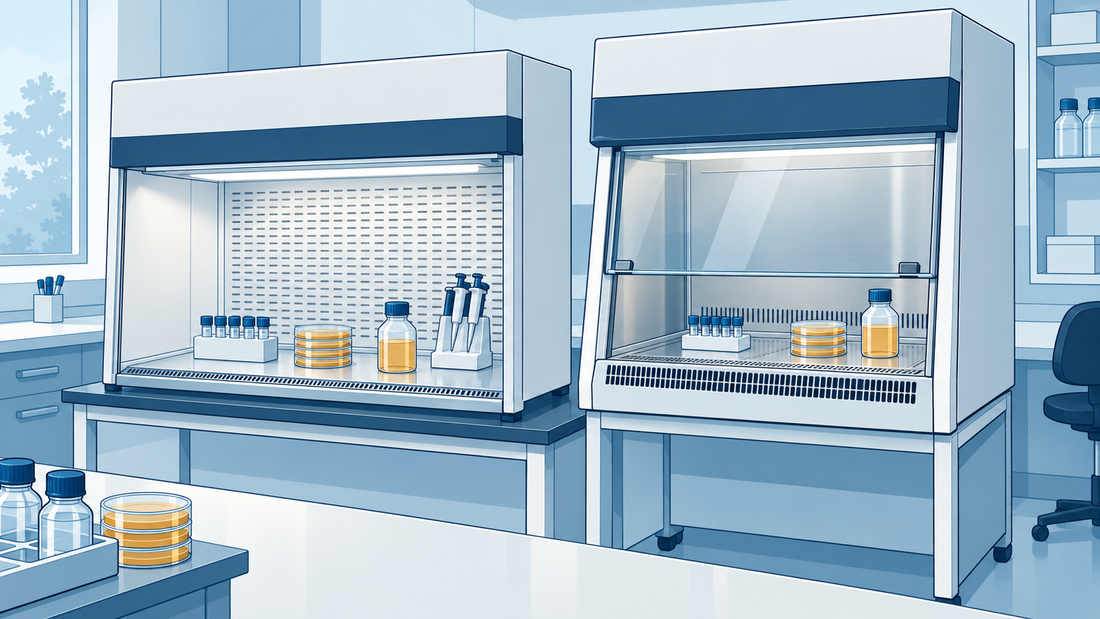
A laminar flow clean bench supplies filtered air to the work area to protect materials. In a horizontal configuration, air crosses the work surface towards the operator. Vertical airflow in a product-protection-only bench does not demonstrate biological containment.
CDC/NIH BMBL, sixth edition, Appendix A explicitly distinguishes clean benches from BSCs. Do not use a clean bench for potentially infectious materials or other hazardous substances. HEPA filtration alone does not establish where air goes or whether personnel are protected.
3. Recognise the purpose of a BSC
A biological safety cabinet is designed for containment appropriate to its type. Class II combines personnel, product and environmental protection, but configuration, installation and operation must support these functions. It is not a universal chemical fume hood and does not make the room suitable for every risk.
Universitat Autònoma de Barcelona’s institutional guidance excludes product-protection-only benches from BSCs. For airflow, connections and tests, see the guide to Class II cabinets.
4. Distinguish chemical fume hoods and other devices
A chemical fume hood draws air to limit exposure to chemical contaminants under specified conditions. It does not automatically provide microbiological sample protection or exhaust filtration suitable for every biological hazard. OSHA fact sheet 3407, revised 2011 describes its protective function in the US context; it is not a universal installation specification.
A recirculating cabinet does not become suitable for vapours because it has a HEPA filter. Assess substances, exhaust, compatibility and failure response. Isolators, weighing enclosures and closed systems have specific designs: a name or integral gloves do not justify transferring an activity.
5. Compare activities, not labels
The original matrix below supports a decision. It identifies candidates to assess, not authorisations to use them.
| Purpose | Candidate device | Protection and limits | Evidence needed |
|---|---|---|---|
| Prepare non-hazardous, contamination-sensitive material | Clean bench | Product; no assumed containment | Documented risk and usable-area performance |
| Biological activity with possible aerosols and sample protection needs | BSC assessed for the use | Containment and product according to configuration | Biosafety assessment and installed verification |
| Operation with chemical vapours | Chemical fume hood or dedicated system | Exposure control, compatibility and exhaust | Chemical assessment and relevant tests |
| Combined biological and chemical risks | Solution defined with specialists | No selection by label alone | Joint assessment of activity and installation |
Simulated case. A laboratory prepares materials confirmed to be non-hazardous but sensitive to contamination, and assesses a clean bench for that activity alone. A second activity presents a biological aerosol risk. It is not moved to the same bench for convenience: the team updates the assessment and defines the necessary containment, installation and competence. No experiments with hazardous agents are described.
6. Write requirements before purchasing
Ask which activities are allowed or excluded, how air recirculates or exhausts and what room conditions are needed. Define actual equipment footprints, ergonomics, filter access, cleaning, maintenance and abnormal-condition response. A low purchase price may not reflect the work needed to install and maintain the solution.
Agree acceptance tests, responsibilities, documents, training and criteria for future changes. Distinguish model testing from site verification. BSC requirements and particle cleanliness requirements have different scopes: the official ISO 14644-1:2015 description addresses particle concentration, not viability or nature. The public scope was consulted, not the full standard.
7. Avoid decision shortcuts
“Laminar flow” describes an airflow regime, “HEPA” filtration and “Class II” a cabinet category: none replaces intended-use assessment. Do not infer sterility, containment or vapour control from one feature.
- Have I identified risks and uncertainties?
- Have I separated sample, personnel and environmental protection?
- Have I checked air destination and compatibility?
- Have I defined tests, responsibilities and use conditions?
- Have I documented who authorises the activity and when to review the choice?
Retain the decision within laboratory organisation, together with exclusions. A change in material or operation requires review before extending device use.
Continue exploring

PL-02-024
Microbiology personnel qualification: aseptic technique and competence
Attendance at a course alone does not demonstrate competence. Link activities, risks, observations and authorisations to the work actually performed in the laboratory.
Read the article
PL-02-023
How to qualify an outsourced microbiology laboratory
Qualification concerns a specific activity, matrix and site. Assess competence, sample handling, data access and responsibilities before assigning the work.
Read the article
PL-02-022
Microbiological OOS results: investigation, evidence and CAPA
An unexpected result requires testable hypotheses, original data and justified decisions. A practical matrix for microbiological investigations and CAPA.
Read the article