
PHARMA LAB · PL-02-017
Environmental monitoring samples: receipt, incubation and reading
In this article
Environmental monitoring samples reach the laboratory with a history that has already begun. A readable plate that cannot be assigned to the correct location, or transport that cannot be reconstructed, may compromise interpretation even when subsequent incubation is satisfactory.
This article starts with the sample already collected. Selecting programme locations, frequencies and levels belongs to another process. The objective is to return information with identity, conditions and limitations that decision makers can understand.
1. Define the handover of responsibility
The EM programme owner defines the information needed; the sampler documents collection; the laboratory receives, processes and assesses the sample under agreed responsibilities. An internal transfer between departments needs the same clarity as dispatch to an external laboratory.
Establish who may accept a sample with reservations, who assesses a deviation and who receives an urgent signal. Chain of custody describes people, times and conditions across handovers: it is more than a final signature. For instrument-generated information, see microbial air samplers.
2. Accept an identifiable sample
WHO good practices, TRS 961 Annex 2, 2011, §8 call for receipt and identification procedures, condition records and consultation with the client when material has problems. Translate these principles into checks appropriate to the matrix and method.
- Identity: unique code, location, environment and connection to the sampling event.
- Collection: date, relevant times, method, operator and volume, duration or area where needed for the result.
- Support: medium or device type and lot, expected status and observed integrity.
- History: handovers, transport conditions, waiting periods and associated records.
- Decision: accepted, accepted with reservations or unsuitable, with rationale and accountable person.
A reservation must also be visible to the result reviewer. Do not complete an illegible code by choosing the “most likely” location. Any permitted reconstruction must rely on verifiable evidence, preserve the discrepancy and distinguish the original information from a later explanation.
3. Control transport and waiting periods
Times and conditions need justification for the support, matrix and method; no single maximum time applies to every EM sample. Consider protection from impact, opening, contamination and changes that could alter recovery. Apparently intact packaging does not by itself establish temperature history.
WHO §7.3 links transport and storage to sample integrity and documented responsibility. Plan for delays, weekends and unavailable incubators. A missing record does not automatically mean an excursion occurred, but limits what can be demonstrated: record uncertainty and assess impact without inventing the missing information.
4. Assign and trace incubation
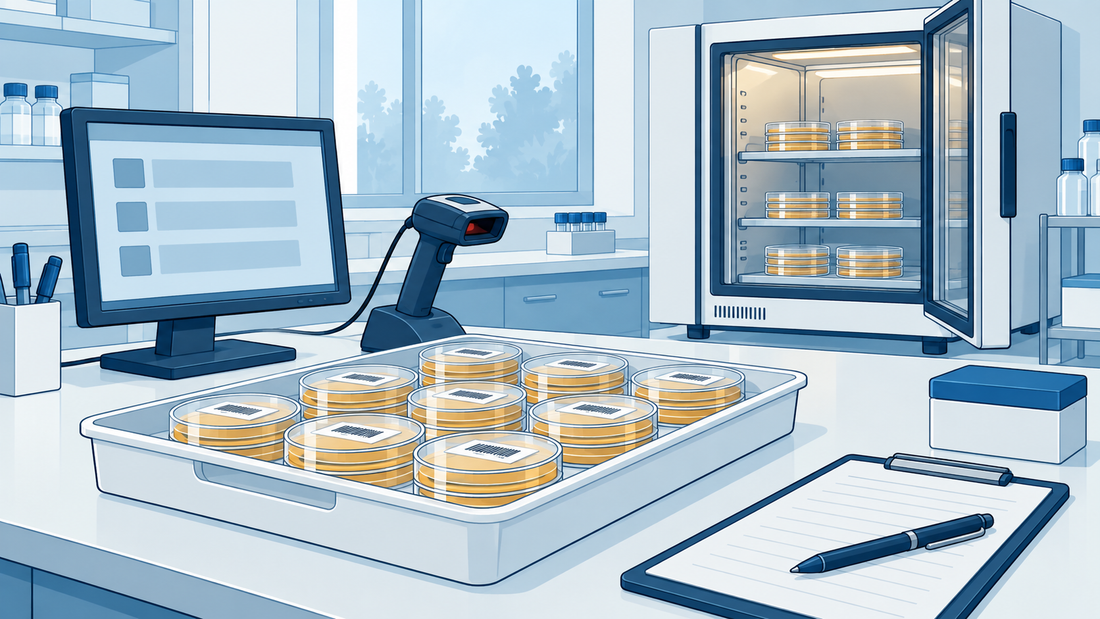
Connect sample, current method, incubator, position and intended sequence. Record start, end and transfers so that a reading can be traced to the actual history. Do not replace actual times with scheduled times.
For loading, monitoring and excursions, use the procedure and the article on microbiological sample incubation. The following original log is a framework to adapt: responsibilities must match the real organisation.
| Stage | Responsible person | Information to connect | Exception to address |
|---|---|---|---|
| Delivery and receipt | Sender and receiver | Identity, times, conditions and transport records | Uncertain label, damaged material or incomplete history |
| Start and transfer | Laboratory operator | Method, incubator, position and actual times | Waiting period, interruption or incorrect assignment |
| Reading and verification | Analyst and reviewer | Observations, count, calculation and correction trail | Non-quantifiable growth or discrepancy |
| Communication and closure | Authorised responsible person | Result status, recipient and linked event and isolate | Urgent signal or assessment still open |
5. Preserve what was observed
A reading must identify analyst, time and sample. Retain the count and relevant observations before conversions or aggregation; separate the observed result from interpretation. Where growth cannot be quantified by the method, do not turn it into a convenient number for the system.
Document relevant morphologies, interference or damage to the support. Images can support review where defined by the process, but do not automatically replace the sample, records or analyst competence. Corrections must keep previous information readable and identify their author and reason under the applicable system.
EU GMP Chapter 4, January 2011, §§4.7–4.9 supports timely recording and traceable changes. A late explanation must be identifiable as such, not backdated.
6. Separate exception pathways
An environmental exceedance, adverse trend, suspect result and sample defect require connected but different assessments. Do not automatically call every EM event a “product-release OOS”. This does not reduce the need to investigate and assess process impact.
EU GMP Annex 1, 2022, §§9.11 and 9.13 distinguishes trends, alert levels and action limits. An action-limit exceedance requires investigation and product-impact assessment; an alert requires assessment and appropriate follow-up. A transport defect does not conveniently erase observed growth.
7. Return a reviewed, usable result
Review connects identity, history, method, observations, calculations, exceptions and approval status. Communicate critical signals within justified times, without necessarily waiting for the final report; clearly identify preliminary information. Link isolate identification, EM event and investigation without turning an association into an assumed cause.
Simulated case. Two plates arrive. The location on the first is illegible; the second is identified but a transport handover is missing. The laboratory retains the evidence separately and contacts the sampler. It seeks independent corroboration for the first and assesses what available records actually demonstrate for the second. If doubts remain, it declares limitations and decides usability with the appropriate responsible people. Resampling does not retrospectively reconstruct the previous event.
Record retention and material management must support review and investigation under justified procedures. Chapter 6, operational from 2014 connects control data, observations and review. For identification outcomes, see identification-system reliability.
Sources and scope
- WHO TRS 961 Annex 2, 2011: public text, §§7–8. Principles for pharmaceutical microbiology laboratories, not a transport recipe.
- EU GMP Chapters 4 and 6 and Annex 1: linked official public texts; versions checked against the Commission’s list on 30 September 2026.
- The checklist, log and case are original editorial tools. They do not define EM frequencies, departmental limits or universal incubation conditions.
Continue exploring

PL-02-018
Microbiological surface recovery: swabs, contact plates and suitability
Geometry, residues and technique change recovery. Assess the path from surface to count without assuming that swabs and contact plates are equivalent.
Read the article
PL-02-016
Microbial air samplers: selection, efficiency and qualification
The same flow rate does not guarantee comparable results. Connect technology, recovery and conditions of use to select and qualify a microbial air sampler.
Read the article
PL-02-024
Microbiology personnel qualification: aseptic technique and competence
Attendance at a course alone does not demonstrate competence. Link activities, risks, observations and authorisations to the work actually performed in the laboratory.
Read the article