
PHARMA LAB · PL-02-018
Microbiological surface recovery: swabs, contact plates and suitability
In this article
Microbiological surface recovery depends on several stages: collection, transfer, possible extraction and detection. Positive growth demonstrates that something was recovered; it does not automatically measure method efficiency. A not-detected result does not prove that the entire surface is free from contamination.
Choosing between a swab and a contact plate must therefore start with the decision to support, not merely the material available.
1. Define the surface, question and unit
Describe material, finish, geometry, dry or wet condition, accessibility and area risk. Clarify whether the objective is qualitative detection, a count per area or information comparable with a historical series. These objectives are related but not interchangeable.
Define timing relative to operations and disinfection. The sample represents the area actually examined under documented conditions: it does not automatically support extrapolation to the entire bench or equipment. Within sterile manufacturing, EU GMP Annex 1, 2022, §9.29 calls for data supporting the recovery efficiency of selected methods.
2. Compare swabbing and direct contact
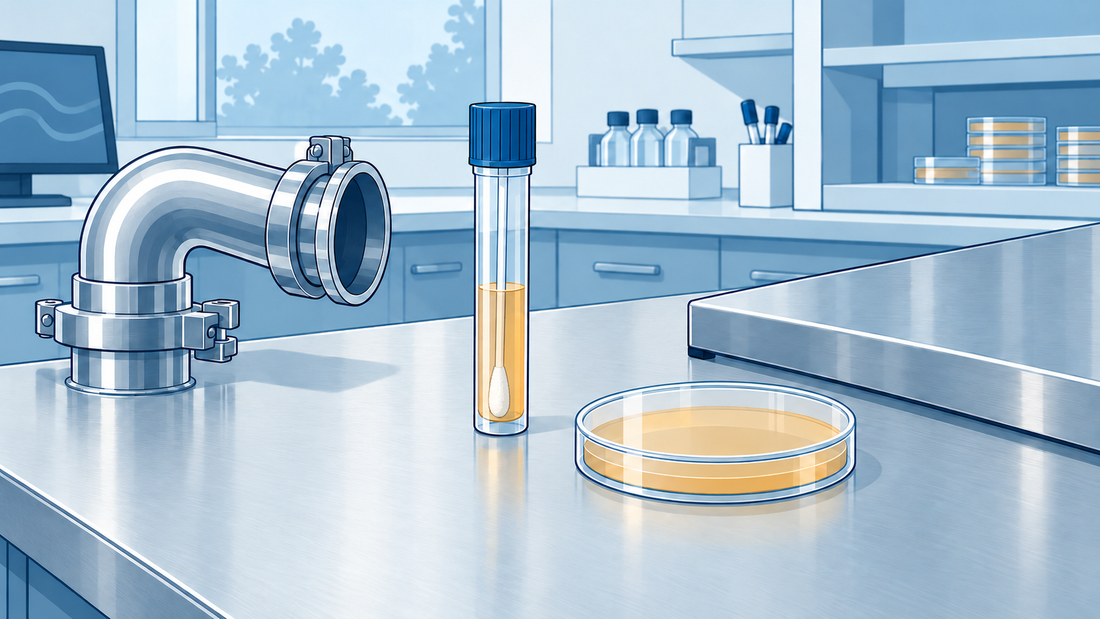
A contact plate transfers material directly from the surface to the medium. It is a candidate for accessible, sufficiently regular surfaces; curvature, joints and discontinuities may prevent the intended contact. Nominal plate geometry does not prove that its entire area was sampled correctly.
A swab may reach irregular locations but introduces variability in collection and release to the analytical system. Check actual accessibility, area definition and subsequent processing. Do not claim universal superiority or equivalent results simply because both are expressed in CFU.
Goverde and colleagues’ 2017 study compares swabs, surfaces and recovery approaches, including actual cleanroom conditions. It supports assessment of the system in context, not a universal choice.
3. Recognise losses along the pathway
Material and roughness affect detachment; residues and surface condition affect recovery and biological response. Actual area, operator technique, support, waiting periods and transfers can also change the result. A comparison that changes all these variables simultaneously makes differences difficult to attribute.
Pinto and colleagues’ 2009 study of contact plates and steel distinguishes surface transfer from the medium’s ability to support growth. This is one reason not to use the growth promotion test alone as evidence for the complete recovery pathway.
4. Separate inhibition from limited recovery
Disinfectant residue can continue acting in the sample. Neutralisation must address the expected residue and be compatible with microorganisms and the analytical system. The word “neutraliser” on a label does not demonstrate control of every interference.
In suitability studies, separate at least three questions: is the residue neutralised, does the neutralising system interfere with detection, and does collection or transfer lose material? Controls must distinguish these effects, alongside relevant negative and performance controls.
The official public preview of USP 〈1227〉, 2019 addresses recovery and interference in pharmacopeial articles. It is a useful conceptual reference, not a universal surface procedure. Do not transfer numerical criteria without checking edition and applicability.
5. Design an informative suitability study
Before testing, define objective, configuration, representative surfaces, justified criteria and exception rules. Representativeness means including characteristics that may change the result, not only the easiest material to sample. Justify repetitions and variability between operators, days or lots according to the decision.
Use reference materials and conditions appropriate to the laboratory’s risk assessment. Compare supplier evidence with local conditions without conflating them. Retain individual results, controls and limitations even when the average appears favourable.
| Surface | Candidate method | Main limitation | Suitability check |
|---|---|---|---|
| Flat, smooth and accessible | Contact plate | Incomplete transfer and uneven contact | Actual contact, recovery and relevant residues |
| Curved fitting or joint | Swab | Difficult access and area definition | Reproducible path and defensible unit |
| Rough or damaged material | Technique assessed on actual material | Retention and high variability | Representative finish and stated limitations |
| Surface with expected residues | System with assessed neutralisation | Inhibition or neutraliser interference | Separate neutralisation and analytical-response controls |
WHO good practices, 2011 frame competence, methods and sample handling. ISO 18593:2018 instead concerns the food chain and excludes cleaning and disinfection validation: it does not automatically become a pharmaceutical requirement.
6. Make calculations and interpretation auditable
Report original count, area actually examined, method, sample processing and final unit. For swabs analysed after extraction, aliquots and dilutions must be considered before relating the result to area. For conversion logic, see enumeration and method suitability.
Simulated example. Assume that the method has already determined 12 CFU recovered from the entire sample representing 60 cm². The result is 12 ÷ 60 = 0.20 CFU/cm². This calculation does not correct recovery efficiency or demonstrate 0.20 live cells per cm². If 12 were merely an aliquot count, the calculation would be incomplete.
Do not compare CFU/plate, CFU/swab and CFU/cm² without a justified basis. Even harmonising units does not make different methods equivalent. “Not detected” retains area, sampling and detection limitations; non-quantifiable growth must be handled under the method, without invented numbers.
7. Maintain comparability in routine use
Simulated case. A smooth bench allows defined contact; an irregular fitting leaves some agar without contact. A swab with a documented sampling path is evaluated for the fitting. If area cannot be estimated defensibly, define a result per site or sample that fits the purpose, without assigning fictitious cm². The two results are not a cleanliness ranking.
Training, material identity and status, technique and sample handling must remain controlled. New surfaces, disinfectants, supports or extraction approaches require change assessment. If a historical series changes after replacement, examine both process and method before interpreting it as environmental improvement or deterioration.
Sources and limitations
- Annex 1 and WHO: public texts; principles applied within their respective scope.
- Goverde 2017 and Pinto 2009: indexed PubMed abstracts consulted; direct opening limited. No complete protocol or percentage data reconstructed.
- USP 〈1227〉: public 2019 preview. ISO 18593:2018: official catalog, published and confirmed, checked on 30 September 2026; full text not consulted.
Continue exploring

PL-02-017
Environmental monitoring samples: receipt, incubation and reading
A count is interpretable when sample identity and history remain connected. Organise receipt, incubation, reading and communication of environmental results.
Read the article
PL-02-016
Microbial air samplers: selection, efficiency and qualification
The same flow rate does not guarantee comparable results. Connect technology, recovery and conditions of use to select and qualify a microbial air sampler.
Read the article
PL-02-024
Microbiology personnel qualification: aseptic technique and competence
Attendance at a course alone does not demonstrate competence. Link activities, risks, observations and authorisations to the work actually performed in the laboratory.
Read the article